My husband and I recently visited David Austin Roses in Shropshire. It set me thinking about why I love roses: the scent, the sweet-shop colours and the silkiness of the petals. But they also have thorns and are beloved by insects such as earwigs. This links to my latest poetry collection, Earwig Country (Valley Press 2024), where the main theme is ‘beautiful things have inner horrors’.
We do have a small Tudor style rose garden within our back garden, with box hedges and some David Austen roses, and others that need a little work, pruning etc. We also have a few which were standard roses but have reverted to wild roses, and are far too large for this miniature parterre. So our visit was partly scoping out replacements. I liked the Olivia rose, and hope to order bare rooted in the correct season. I can’t see a rose without sniffing it for its scent, and will only buy scented ones. Everywhere I go I see roses and apply my nose to them, and have done since I was a small child. They are indeed ‘olfactory delights’ (quoting one of my own lines there).
My dad loved growing roses and so did my father in law. I thought I would share this poem from my earlier collection, in which my husband and I are sorting out his parents’ garden after we have had no choice but to move them into a retirement fla t where we could keep a better eye on them. It’s from my 2016 collection The Five Petals of Elderflower.
Late Roses
All day we have been working, side by side in your childhood garden, lopping shrubs, eradicating brambles snipping dead heads, yanking weeds.
October roses emerge in vibrant hues: oranges, golds and crimsons, with thorns which rip our clothes and flesh. Their scent is a reward for labour.
Your parents’ tangled minds are clogged with memories, resurfacing as they approach their nineties. We have assumed control.
Safe in their new apartment, they cling to routine, repeat old stories, laugh, are mostly thankful for our care: roses late flowering against the dark of winter.
My very first collection, back in 1988, Dandelions for Mother’s Day, was prefaced by an epigraph from Emily Dickinson : ‘Essential oils are wrung/ the attar from the rose/ be not expressed by suns alone/ it is the gift of screws’, which I felt suited what I was aiming to do in my work, distill things down to essentials.
Roses have always been important to me and we are approaching rose time, which can go on right till frost comes.
Tell me in the comments, have you ever written about roses? Feel free to share you poem here.
Truly delighted to have this new poem published on this cool webzine today, after I finally got my finger out and submitted some poems. Am currently on medication for a bad cough, so this has cheered me up.
This poem came out me wiping round our kitchen daily and noticing just how many crumbs accumulated every day. This is probably because we like food, and cooking, but it made me reflect on how crumbs measure our days, show what we have been making to eat, and record our comings and goings.
Black Nore is a really cool magazine. Lots of good poems on there, free to read.
Apologies for not updating my blog during January. I must have some bearlike qualities, because I hibernated in January, though I have been working a little in my study, with a fire lit. I didn’t go out when the snow was on the ground, for obvious reasons.
However February has been a little more out-facing. I had two gigs recently. One of them was for a local WI, and I had such lovely comments afterwards, and even sold a couple of books. I selected poems that I thought would appeal to the audience, as I always do, and they were such a lovely audience to read to, because they got all my references, many of them being a similar age to me and with similar backgrounds. I led a small writing workshop for them and in the Q&A, they asked some interesting questions. I would love to do more for local WI groups. The fees may be modest but the rewards are great, simply connecting with people beyond the world of poetry, but who relish the opportunity to hear poems from me.
The other was at Poetry Whitchurch, which is a high quality open mic night, which features a guest poet. It happens at Percy’s Bar in Whitchurch, which is an extremely quirky place. The step up to the stage was quite high, so they set it up for me to read from the front of the stage on a chair, because my sets were a little too long for me to do them standing. I was invited by poet Helen Kay and introduced beautifully by Harvey Vasey, the host. Very few of the poems I read were the same as the WI gig. I always plan a bespoke set to suit the audience and venue. The open mic, in which everyone got to do two poems, was very entertaining and everyone performed well. It was a bitter cold night but the atmosphere was warm.
The photo is of me reading from the front, and features their new banners. I couldn’t help but think of my dear friend Ian Parr, who always supported me and other poet friends. He would certainly have been there, were he still alive and able to attend.
It is a pleasure to recommend this cheery new Christmas anthology. Like all the Poem a Day books, it has a suggested date on which to read each poem. I love the cover, with its iconic images which recognise many of the pleasures of the season, particularly the apt Twelve Days of Christmas song. These poems are personal favourites of the editor, Allie Esiri, which is a strength, because it means each poem has been chosen with love.
Christmas is a time for favourites and traditions, so Esiri has included some of these. Traditional rhymes and songs feature, such as ‘Christmas is coming and the geese are getting fat’, carols ‘I Saw Three Ships’ and ‘The Holly and the Ivy’, which are some of the more unusual ones, and favourite poems like Rossetti’s In the Bleak Midwinter’ and Thomas Hardy’s ‘The Oxen’. There are also songs like ‘Jingle Bells’ with all the verses, which are often forgotten and totally delightful. However, interspersed with these well known pieces are modern poems, which I will discuss in more depth.
The second of December has Wendy Cope’s monorhyme quatrain:
At Christmas little children sing and merry bells jingle, The cold winter air makes our hands and faces tingle And happy families go to church and cheerily they mingle And the whole business is unbelievably dreadful, if you’re single.
This choice so early on recognises that not everyone enjoys the season, and brings in a welcome note of reality, but in an amusing way. It is followed by a fantastic poem by Clive James, that is new to me. It is called ‘The Crying Need for Snow’. It’s worth remembering this anthology is aimed at children and families, and I love that Esiri has not dumbed down her choices. The vocabulary in this poem is challenging, using words like: ‘besotted’, ‘precipitate’, ‘plebicite’ and ‘multifarious’, words children will enjoy the sound of, and within the context of the poem, the meanings are clear. It’s a very visual poem, longing for snow to tidy up the scene. It also has amusing words in it like ‘wig-wag line’, ‘fluffy stuff’. It’s a very charming and unusual poem with a clever rhyme scheme. Next day we have Edwin Morgan’s delightful poem ‘The Computer Writes a Christmas Card’, which is a fun idea, playing with the words we associate with Christmas, creating kennings and new words. This should cheer people up when we are toiling to write Christmas cards to far away friends.
Clare Bevan’s poem, ‘Just Doing My Job’, is spoken by a child who is playing one of Herod’s henchmen in the school nativity play. Kudos to schools where clever teachers find a way to involve every child!
On the 6th of December, the Christmas Tree makes an appearance with E.E. Cumming’s delicate ‘little tree’ and an amusing shape poem by the inventive Brian Bilston. I’m pleased to see Zephaniah’s ‘Talking Turkeys’ here, and later on a Lemn Sissay poem, ‘Let there be Peace’. Both poems make their point in a fun way. An extract from ‘A Child’s Christmas in Wales’ and W.B. Yates ‘He Wishes for the Cloths of Heaven’, along with ‘Auld Lang Syne’ as the final poem, help make the choices inclusive of all communities within The British Isles, all gathering like family together and having a big Christmas party.
The 10th December features a hilarious poem from Ian Duhig on the horrors of Christmas shopping, featuring the ‘White Rose Centre’. His musings on fighting his way through the crowds and the noise are many layered. It’s impossible to describe, it has to be read – another good reason to buy this book!
The 14th has an impeccable lyric from Oliver Herford, which reminds me of Hardy’s ‘The Darkling Thrush’ (not included) having the same hopeful note. John Greening, on 17th, brings music into the festival, with ‘All I Want’, mentioning several Christmas favourites and the memories they evoke, and enjoying his Alexa device for listening to them all. Another gem is from Gareth Owen, ‘Saturday Night at the Bethlehem Arms’, told from the viewpoint of the Innkeeper, and full of mystery, like who is the stranger sitting in the bar? There are hints of danger in the poem that are kept secret but the reader can guess.
The choices move on to gifts. Of course ‘A Visit from St Nicholas’ by Clement Clarke Moore HAS to be there on Christmas Eve, and the ‘Twelve Days of Christmas following, balanced out by Bilston again, with a hilarious sequel about the nuisances caused by the gifts, which takes the form of a conversation.
There’s no poem for me as good as Eliot’s ‘Journey of the Magi’ for the 27th December, and following it up with another stunner, ‘Innocent’s Song’ by Charles Causley is a stroke of brilliance. I had not previously known ‘The Gift’ by William Carlos Williams, and I am delighted to make its acquaintance. The 30th of December has a fitting extract from Tennyson’s touching masterpiece ‘In Memoriam’, ‘Ring out, wild bells’, with New Year’s Eve seeing the year rung out with his trusty favourite.
The pages are decorated with holly sprigs which is a nice touch.
If I have a criticism of this anthology it is only that I would have liked to have seen some poems by U.A. Fanthorpe who wrote so many wonderful Christmas poems. She would be in MY personal favourites, but one cannot complain to be reading a personal selection by an editor as accomplished as Allie Esiri.
I highly recommend this book. I can’t think of anyone who would not be pleased to find this book wrapped up under the tree or in their stocking. I hope it does well. There is a nod to everyone’s preferred Christmas, lots of humour, balanced out with serious reflective choices. It’s fabulous!
It is a pocked size hardcover published by Macmillian children’s books at a cost of £8.95. There are 80 pages and the recommended age is 12+, but I think any child or adult would like this.
Thank you to Tory Lyne-Pirkis, for sending me the PDF and inviting me to review this book. I thoroughly enjoyed getting in the mood for Christmas by writing it.
Last week I had the privilege of hearing Helen and Martin read from their new, very different books, at Wirral Poetry Festival. They each did two fifteen minute sets, which only whetted my appetite for more. I acquired both books and want to offer a flavour to those who have not yet purchased copies.
Constructing a Witch has been coming together for some time. The theme can be traced back to Ivory’s earlier collections, but in this book all the research and previous work in this area comes to fruition. The collection was a PBS recommendation and also includes colour photos of Ivory’s fascinating art work. Ivory is a skilled manipulator of language to create both precision and music in her poems. She looks at all the different ways women have been called witches, othered by the patriarchy, silenced, murdered, persecuted. She traces a line from the past and the cruel treatment of supposed witches, but links all to the present day, where women remain unsafe. There are poems about particular women executed as witches, informed by visits to places notorious for witch trials. Historical themes such as how brewing was taken away from women, and how women’s hair is fetishised, resulting in shaven heads as punishment, and many more, such as the witch mark and the humiliation of the search for it. There are also spells of reclamation, such as ‘Spell to Take Back the Night’, and empowering poems about the menopause. Despite some of the dark themes, the collection is spiced with some pointed humour at times. Overall the poems come together to celebrate women in all our power and strength. It is an important book.
No less important but highly contrasting, Martin Figura’s collection dwells on what it means to be a man in today’s world. The moving title poem has Figura’s classic surreal quality. I read this poem to be about all the men who were laid off when the mines were closed, or factories shut down, and who could not get other jobs, and therefore lost all sense of purpose. They stood about in the deserted industrial towns and gradually turned into monuments. The poem is a lament for men like this, men of my father’s generation, who had worked hard all their lives only to be let down by politicians, and the shift away from industry. There are poems about former Prime Ministers and Presidents, seen through Figura’s pointed and satiric gaze. The book opens with poems about his own childhood and Liverpool, the place of his birth (a city close to my heart). A moving poem ‘My Mother, My Father’ imagines how things might have been had his parents never met, and their ill-fated marriage never happened. This group of poems picks up and develops some of the themes from his ground-breaking book Whistle, and culminates with ‘The Leaving of Liverpool’ and ‘Dead Dad’. There are heart-breaking poems about looked-after children, which he has some person experience of, alongside poems about Salisbury hospital staff. There are illustrations in this book too, in the form of photographs. Most readers will know Figura is an accomplished photographer. Figura’s humanity and ability to wring out our hearts with a telling detail or two, runs through the collection. He is one of those poets who can make us laugh and cry in the same poem.
This piece is not a review, just a flavour of two brilliant collections I am looking forward to reading in depth and again and again. There is much to ponder and relish in both of them. These books fit together as well as their authors do, and are as good company as they are. Many congratulations to both of them for these recent achievements.
I am delighted to be leading a poetry workshop on Tuesday 15th October, 11am to 12.30 pm, as part of this Elders Programme, created at Storyhouse Chester. It is from 14 to 18 October and the idea is to combat loneliness through art. There are all sorts of events included, such as a Heritage walk, photography ramble, open mics, a film. Check out the Storyhouse website.
An opportunity to work with a poet to take you through some exercises on how to get started with poetry.
If you already have a love of writing poetry, come along and enjoy the space to write with other like-minded people.
This session will be led by Poet, Angela Topping. She is also an experienced teacher and holds Masters degrees in English Literature and in Arts in Education. She leads workshops with all ages from nursery to elders, building confidence in their ability to write, tell stories and make books. She is the author of nine poetry collections and four pamphlets. Her most recent book is Earwig Country Valley Press 2024). She is a former writer in residence at Gladstone’s Library, Hawarden. Her poems have won competitions and appeared in prestigious poetry magazines including Poetry Review and Magma.
I’ve designed it so it is suitable for beginners, but there is plenty for the more experienced poet to tackle, and the exercises progress during the course of the one and a half hours. You will have new drafts to take away, handouts created specially for this workshop. I usually pack a lot into my workshops, so there is plenty to go at.
This was my second festival leading the poetry workshops as a disabled artiste. I was lucky to have an accessible venue and a really lovely group of people attending, some of them regulars, others new people. Most attendees returned to all four sessions. Each session comprises a ‘hot penning’ warm up from a prompt line, followed by two detailed exercises, which often include notes and a range of stimuli. Some are especially appropriate to Whitby Folk Week, others more general. We have some silent writing time and some sharing time with feedback. Every year I am impressed by the quality of work produced. Our last session is always one exercise preceded by a hot penning, then the last hour is a readaround where every participant reads two poems (if they wish) and I conclude with a short reading of my own work. This gives a satisfying close to the four sessions. I had some fabulous attendees this year and I hope they will return in future.
Whitby is a challenging place for a disabled person, with its steep hills and old buildings, its quirky alleys and steps. So how did I manage? It’s not easy to find accessible accommodation, and we ended up on the East Side, my husband driving me to my workshops and concerts. The Rifle Club, where I was leading, has a kerb to mount and then one step, which I can manage on my walker, there is parking and the toilets are on the same level. I can attend a concert there, upstairs, using either the chair lift or the double handrail on one of the sets of stairs. Double handrails are something I wish more places would add, because they make a massive difference to me.
There is a brief guide to accessibility of venues in the programme, but no two disabled people are alike, so I thought I would offer my notes for others to see. The Metropole Ballroom is wheelchair accessible because there is a ramp and an accessible toilet. There is a small car park for customers, but it is also possible to park on the street with a blue badge. This is a lovely large level room and a great venue for folk week, with a bar at the back. There’s also a handrail on the steps at the side. We stayed in the Met for ten years, but though there is a lift to the flats, it is unreliable and so I am not sure I could risk it if there was a fire, as it would take me a long time to do the many stairs.
The Spa (The Pavilion) is wheelchair accessible too. There is parking down the bottom of the access road, with a few disabled spaces, and there is an accessible toilet with an automatic door. The Spa theatre is also completely accessible, and there is another accessible toilet by the door on your way out. There is no tiered seating, so it was easy for me to come and go, with just a slight slope to give those sitting at the back more chance to see. A venue we didn’t try in 2022 is the Coliseum Theatre. There is space to drop off, a ramp into the building, an accessible toilet, a lovely cafe/bar and though the theatre has tiered seating (not much leg room) the bottom row is accessible, and during folk week extra chairs are put out on the floor.
These were the venues we used this year, but I may try more in future. We mostly ate in the flat, and because I was working, didn’t have time to eat out. I needed lazy mornings after working, then leading my workshops and going to concerts every night. We did get fish and chips on our first and last night and some of the Rifle Club’s homemade sandwiches and cakes. I do miss pottering round Whitby’s shops, especially the second hand and charity shops, and maybe there will be more time to try some next year. I’ve come a long way from the year (2021) when I never left the flat and was still in a wheelchair, but the festival wasn’t on that year anyway.
Concert highlights for me this year were: The Hunch, Gordon Tyrrall, The Wilsons, Lynda Hardcastle and Alan Rose, Belinda Kempster and Fran Foote, Ken Wilson, Melrose Quartet, Vicki Swan and Jonny Dyer, and Pete Coe. Sad to say, I didn’t see any dancing, didn’t see other favourites because I focused on venues I knew I could safely manage, and because I could only find Friday to Friday accommodation, I missed some brilliant stuff on Friday, including the closing ceremony. However, I now know for sure I can cope with the festival, which brings me so much joy.
Jackie Hagan’s death has left the poetry community in Manchester and further, bereft of the most amazing person. The disease she had lived with, which caused the loss of two limbs, finally claimed her. Jacks was only in her early forties but the impact created by their presence was truly amazing. Jacks was so bright in the way they dressed, lived, smiled and related to people. Their poems were long and loose, filled with wry insights and observation that evoked both laughter and tears. I loved the accent, having a close relationship with Liverpool myself but not from there, I identified. Jacks was from Skem (‘our imaginary town’), a Liverpool overspill town.
I met Jacks a short while into her performance career, and was impressed by their energy and uniqueness. There was no-one else writing or performing anything like that. I don’t think Jacks noticed me: it was at a book launch at the Green Room in Manchester with so many readers. I heard them perform a few times after that, but missed lots of other chances. However, my dear friends Steve Waling and John Calvert were going to Magical Animals, and said they would look after me. I wanted to read but was very nervous about how my work would go down, because I am not a ‘performance poet’. (By which I mean I don’t know my poems by heart and they are not scripts) However Jacks gave me a ton of encouragement and a lovely introduction, and so I read my two poems, and later, Jacks sent me two photos I was in. I had a wonderful time, despite my nerves. Jacks made everywhere a safe space where anyone could find a place.
I never knew Jacks very well, but watched from afar and admired their attitude to life, which could be summed up by the phrase ‘get stuck in’. Jacks was incredibly intelligent, and her poems are all about the human experience. Jacks loved the brokenness in people and I wish I’d known someone like them when I was the weird kid at school. Jacks always made people feel they were OK.
The last time I saw her in the flesh was at Postbox Poets, a night organised by Sarah Dixon. I think I had a guest slot, but can’t be sure. I was there with Steve and John, my husband Dave had driven me there, so maybe I did have a slot. Anyway, Jacks took a slightly blurry photo of the three of us, me with John and Steve either side of me and said they loved us and were we not great mates. I still love that photo. It was so perceptive of Jacks to notice our quiet bond.
I stayed in touch with Jacks on Facebook, lost in admiration by the way they handled things through hospital procedures. At no time was Jacks’ sense of self lost, there was so self-pity. Jacks used the time to get to know people on the ward, and make their lives a little bit shinier. The humanity Jacks demonstrated towards them was impressive. I modelled by own attitude when I was in hospital with my fracture, on Jacks’. I learned loads from Jackie Hagan and I think there will be many others who feel the same. Those who were close friends were very fortunate but now are most bereft, and I think of her mum and brother and her lovely partner Miles.
I wrote a poem for Jacks, after Jacks, and sent it to Miles to be written on her coffin, decorated by friends. It’s not much but I’ve tried to show what I learned from Jacks, and how knowing them the little I did made my life more special.
For Jackie Hagan
Who showed it was ok to be working class even after you’d lost your accent, like me it was more than OK to be dressed out of jumble sales OK for a page poet to read at Magical Animals – with an intro just as good as all her mates had OK to be scared OK to be broken, Jacks understood brokenness OK to rebel and act daft and tell things like they are OK to be however you are, love who you love OK to be disabled, you can still rock up with glitter on your disability, be proud of survival OK to be overweight or too skinny OK to dye your hair mad colours, make a rainbow OK to be nosy, dead interested in everyone’s life even if they are old and grumbly or losing their mind OK to be human in fact. OK to laugh and dick around and cry if you need to, OK to swear. All that is good for you, get it out, express yourself. Goodbye bright star, glitter pixie who showed us how to live and how to die. In a world without Jackie, we all have to be more Jackie.
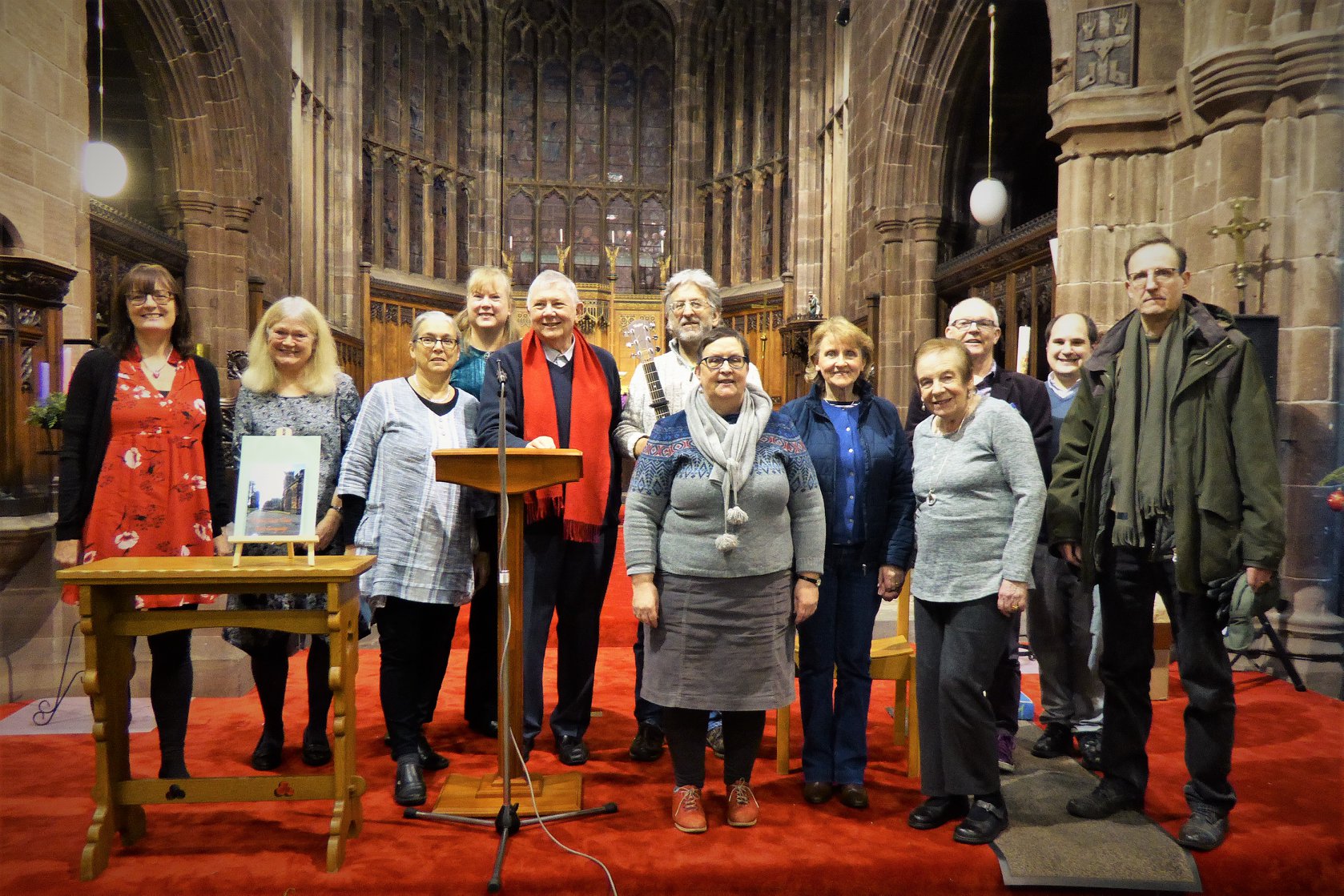
I first met Ian Parr when he started coming to my Poetry Society Stanza group, Blaze. Right from the start, Ian was chatty and convivial, and keenly interested in poetry. He was also a member of Chester Poets. He had lived in Northwich for many years before I knew him, a fact which became apparent when I was asked to put together a poetry project for St Helen’s Church, Northwich. I invited Ian Parr and Kemal Houghton to be part of it, and we each led workshops at one of their open days, in a rotation, so everyone had three workshops to attend. The anthology we produced was called Stones Have Their Own Language, taken from Ian’s sequence ‘One Perpetual Place’. Eight of Ian’s poems were included, and nine of his photographs. His impact on the project was massive. All day his friendly energy crackled through the church, and at the selection meetings he was modest and helpful. It was truly a collaborative project and we finished it with a launch in the church, the winter before the Covid lockdown. Ian had moved further into Shropshire by that time.
You can see Ian there, right at the heart of the project, wearing his trademark red scarf. I asked him about it a long time ago and he explained it was in memory of a friend who had died. That is typical of Ian: he was the sort of person who valued friendships very deeply.
Ian was very knowledgeable about both poetry and folk music – two passions we shared. He would pop up in unexpected places with a smile on his face, delighted by my surprised reaction. One year he turned up at Whitby Folk Week. I’d gone to the Spa to collect my artist passes and I heard a jolly ‘Hello Angela’. I did a double take and he laughed! I bumped into him a few times and he even attended some of my workshops. I was reading in Shrewsbury, and didn’t expect him at all, but there he was, again with that cheeky smile and kind eyes, saying he had come to support me. He’d heard me read from that collection several times already and I was so touched he was coming back for more. That support was given to all the poets he knew and counted as friends. We will all have our own special memories of Ian Parr, and I invite anyone to post tributes below in the comments.
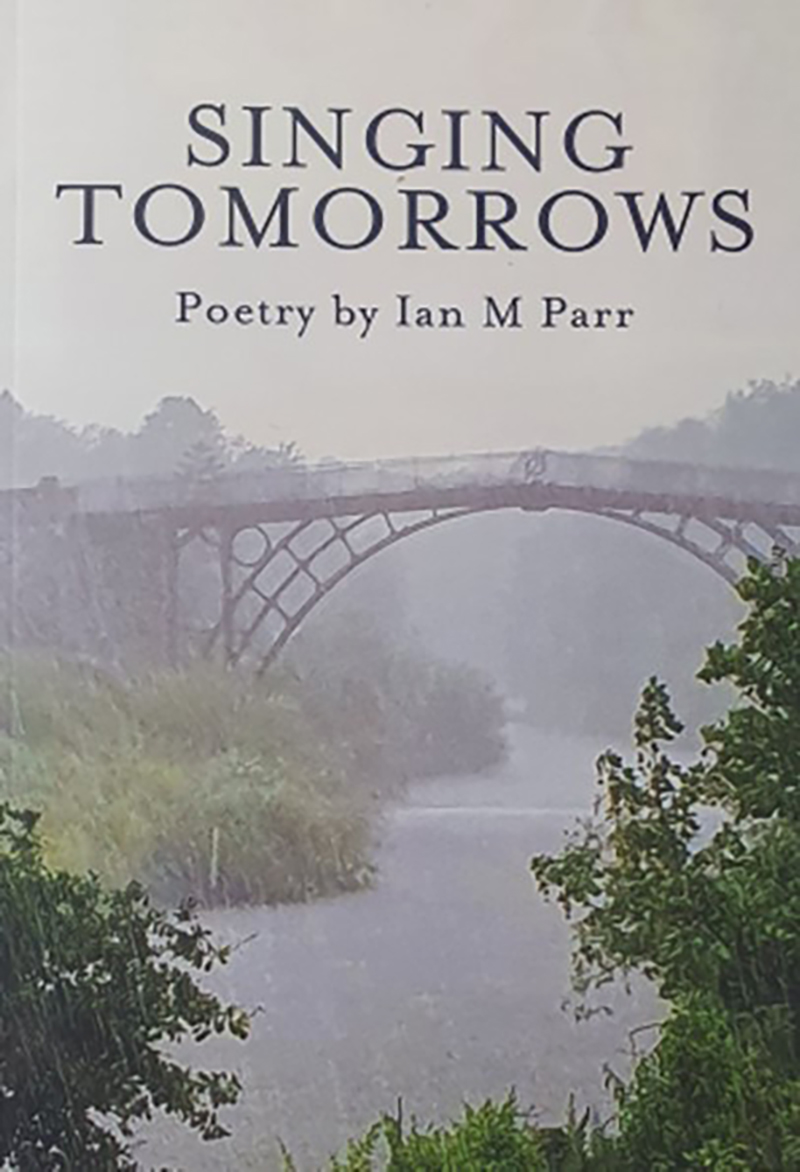
Ian had let me know of his illness and I was hopeful he would survive, having had all the treatment offered, and a loving partner to give him everything to live for. He was working on his own collection of poems and asked me if I would endorse it for him. I was very proud to do so. It was called Singing Tomorrows, and the lovely cover featured one of Ian’s own beautiful photographs. His positivity and zest for life spilled into everything he did.
This is my endorsement: ~ Parr has been honing his craft ever since I have known him, and this book is a very welcome debut. Here are poems which share the joys of nature and folk music in a sure-footed way, able to balance minute plants like ‘Birdsfoot Trefoil’ with a sequence on the planets. Favourite people and places are celebrated. Parr can handle both formal verse and free verse, and while some of these poems are leavened with humour, in the end the reader’s impression is of moving and tender poems which nestle at the heart of this collection.
Angela Topping
Let this stand as my tribute to this talented, modest, sweet and friendly man, who was an old-fashioned gentleman with all the courtesy and kindness that implies. He is missed by so many. I last saw him last June when he was good enough to attend a poetry night I was running at St Helen’s church. He came with his lovely partner, who made him very happy, and read a poem at the open mic. He was a very accomplished reader too.




 Angela Topping